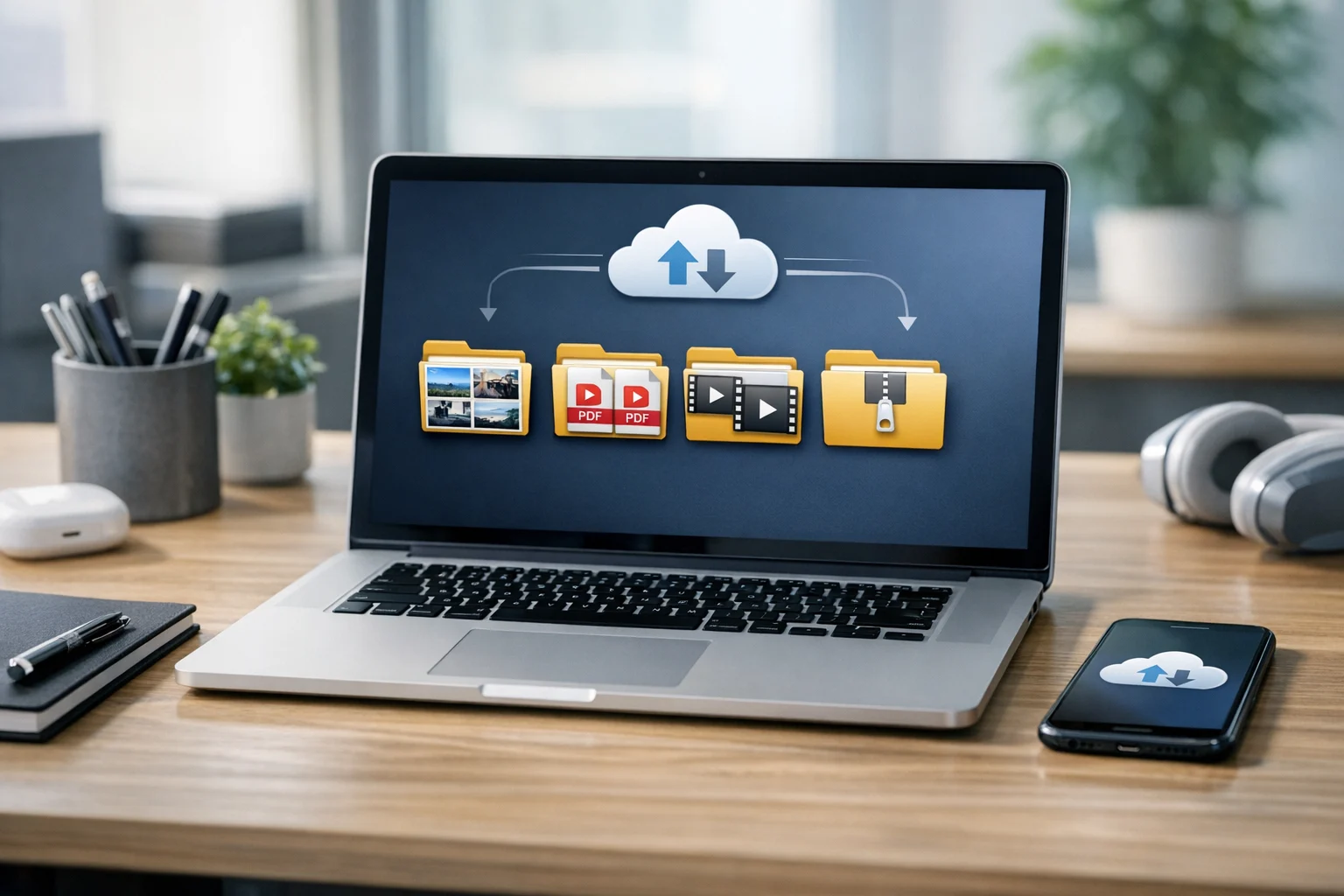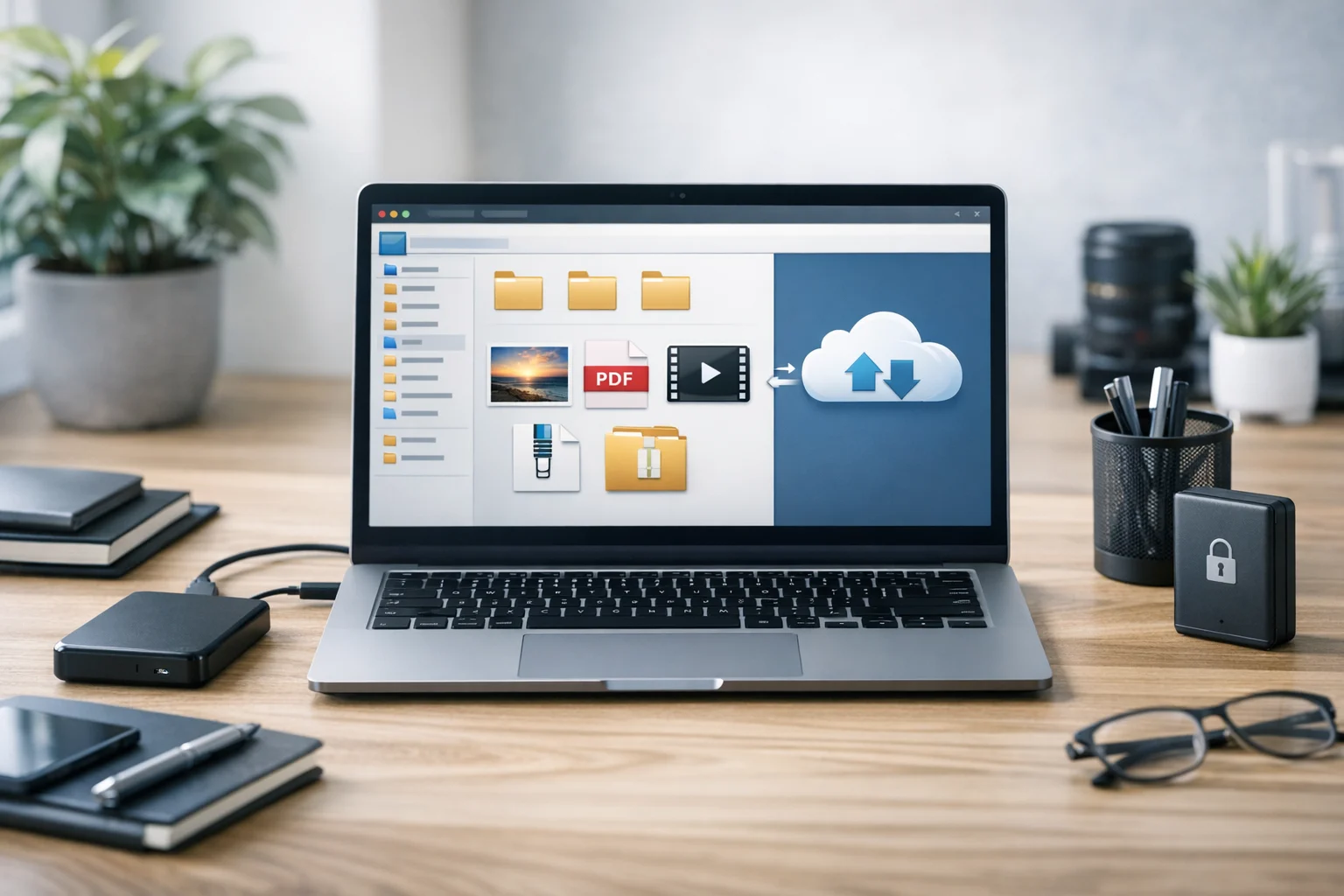

Files pile up fast when you're studying, creating content, running a small business, or just trying to keep everyday documents organized. One person sends a PNG, another uploads a MOV, a client wants a PDF, and your course portal only accepts a smaller file. Before long, you're renaming random downloads, hunting for the latest version, and wondering which format is actually right.
A practical workflow solves that. Instead of treating every file issue as a one-off task, you create a repeatable process for receiving, converting, compressing, storing, and sharing files. This matters for students submitting assignments, creators exporting assets for web and social, and small businesses managing contracts, invoices, marketing media, and internal records.
You do not need a complex system. A solid workflow usually comes down to a few habits, the right file converter for the job, and a reliable place for cloud storage and file backup. With ConvertAndStore, you can handle online file conversion and storage tasks in one workflow, which makes it easier to keep files usable, organized, and ready to send.
What a practical file workflow looks like
The most useful file workflow is simple enough to follow every day. Whether you're dealing with school projects, design drafts, sales decks, or product images, the basic flow stays the same.
- Collect files from email, downloads, phones, scanners, or collaborators.
- Rename and sort them so you know what each file is and where it belongs.
- Convert formats for compatibility, quality, or smaller size.
- Compress when needed so files are easier to upload, store, or send.
- Store final versions in a clear folder structure.
- Back up important files so one device failure doesn't wipe out your work.
If you skip those steps, file management gets messy very quickly. The wrong version gets shared, the format doesn't open on another device, or the file is too large to upload. A consistent system keeps friction low and helps every file move from raw input to finished output without confusion.
Start with intake, naming, and folder rules
Before you convert anything, decide where incoming files go. Many people lose time because files arrive in five different places, such as a downloads folder, desktop, email attachments, messaging apps, and phone galleries. Create one intake folder where all new files land first. From there, move them into project folders once they're named properly.
A clean naming pattern makes conversion and storage much easier. Good file names should tell you what the file is, which project it belongs to, and whether it's a draft or final version. A simple pattern like project-name_date_version works well. For example, marketing-banner_2026-05_v2.png is better than final-final-new.png.
It also helps to separate folders by stage. Many students, freelancers, and office teams use a structure like this:
- Raw for original downloads, camera exports, and untouched source files
- Working for files currently being edited or converted
- Final for approved versions ready to share
- Archive for completed projects that still need to be kept
This reduces accidental overwrites and makes it easier to decide what should be converted, compressed, or backed up.
Use the right image format instead of guessing
Image files are where many workflows start to break. A student might upload a screenshot that should have been a PDF. A creator might send a giant PNG when a lightweight web format would do. A small business might store product photos as whatever came out of a phone camera, without checking quality or file size.
If you're trying to choose the best image format, there isn't one perfect answer for every case. The right choice depends on what you're doing with the image, where it will be viewed, and whether you need transparency, sharp text, or smaller size.
For day-to-day tasks, ConvertAndStore's image converter tools are useful when you need to convert image files quickly without installing extra software. That's especially helpful for students working across school devices, creators preparing web assets, and teams handling mixed files from different sources.
JPG vs PNG
The JPG vs PNG decision usually comes down to content type. JPG is better for photographs and realistic images because it keeps file sizes lower. PNG is often better for screenshots, logos, diagrams, and anything with transparency or crisp text edges.
Choose JPG when:
- You need smaller file sizes for uploads or email
- The image is mostly photographic
- A slight quality loss is acceptable
Choose PNG when:
- You need transparency
- The image contains text, interface elements, or line art
- You want sharper edges and fewer compression artifacts
For example, a student turning lecture screenshots into study materials may prefer PNG for clarity. A freelancer sending preview photos to a client may prefer JPG because it's lighter and easier to send. If you receive the wrong type, converting it is often faster than re-exporting from the original app.
WebP vs PNG
The WebP vs PNG comparison matters most for websites, portfolios, online shops, and social assets. WebP usually produces much smaller files than PNG while still looking good, which makes it a strong choice for web delivery. PNG still makes sense when you need broad editing compatibility or transparent graphics that must stay as clean as possible during production.
If you're publishing images online, a dedicated JPG to WebP converter can help you reduce page weight without changing your visual workflow too much. A common pattern is to keep a high-quality original in your working folder, then export a WebP delivery copy for your site or landing page.
This gives you flexibility. You preserve your editable source while still optimizing what visitors actually download.
Build a PDF workflow that supports sharing and storage
PDF is still the default format for professional sharing because layout stays consistent across devices. That's why students use it for assignments, businesses use it for proposals and invoices, and freelancers use it for contracts, briefs, and deliverables. A good PDF workflow can save a lot of cleanup later.
Use a PDF as your final share format when you need stable formatting. If you receive documents in mixed formats, a good PDF converter helps normalize them before sending, storing, or submitting. ConvertAndStore's PDF tools are helpful when you need to convert PDF files, reduce size, or create a more shareable version of a document.
Some of the most common PDF tasks include:
- PDF to JPG when you need slide previews, image attachments, or fast visual references
- Image to PDF when you want to turn scans, notes, receipts, or whiteboard photos into one structured document
- PDF compression when a portal or email system rejects large uploads
- Merging pages into one cleaner file for document storage
This is especially useful for admin teams and small businesses. Instead of storing separate image scans, screenshots, and exported pages across different folders, you can convert them into one organized PDF for easier document storage. Students can do the same with reading packets, assignment scans, or application forms.
A simple rule works well here: keep one original editable file if you still need to revise content, then create one final PDF for sharing or record keeping.
Convert video for compatibility before you share it
Video files are often the biggest troublemakers in a workflow because they're large, slow to upload, and not always compatible with every platform. Creators deal with this daily, but so do teachers, marketers, product teams, and businesses sending demos or training clips.
The biggest format question is usually MP4 vs MOV. MOV is common from Apple devices and editing software, while MP4 is more universally supported across browsers, websites, learning platforms, messaging apps, and business tools. If you need the safest share format, MP4 usually wins.
That doesn't mean MOV is bad. It's often fine as a source file or edit master. But when it's time to send, upload, or publish, many people need to convert video files into a lighter, more widely playable format. That's where a reliable video converter becomes part of the workflow.
If quality is your main concern, it helps to follow proven export habits instead of randomly lowering settings. ConvertAndStore's guide on how to convert video files without losing too much quality is a good reference when you want smaller, easier files without making them look obviously compressed.
A practical video routine looks like this:
- Keep the original camera or edit export in a raw folder
- Create a delivery copy in MP4 for sharing
- Lower bitrate or resolution only when needed for upload speed or storage
- Test playback on one or two common devices before sending widely
This keeps your master intact while making sure the file other people receive actually opens and plays smoothly.
Use archive files when folders become hard to move
Once a project includes many files, such as images, PDFs, spreadsheets, design exports, and notes, sending them one by one becomes annoying. This is where archive formats help. A ZIP archive is the easiest choice for most people because it's widely supported and simple to open on almost any device.
A RAR archive can also be useful, especially when you want stronger compression or split archives into smaller pieces for easier transfer. That can help with bulky media projects or old project folders that need long-term storage.
ConvertAndStore's archive tools are useful when you need to package folders, manage compressed files, or make transfers cleaner. For many users, file compression is less about saving a little space and more about making large groups of files easier to upload, move, and store as one package.
Use a ZIP archive when:
- You want the easiest sharing option
- You're sending standard project folders to teammates or clients
- You need something quick and broadly compatible
Use a RAR archive when:
- You need stronger compression for larger collections
- You want to split a big archive for transfer
- Your recipient is comfortable extracting RAR files
Archives also make finished projects easier to store. Instead of leaving hundreds of loose files in active folders, you can package the project, label it clearly, and move it into archive storage.
Store final files with backup and privacy in mind
Converting files is only half the job. After you've created the right version, you need a place to keep it. Good cloud storage should make files easy to access, easy to share, and hard to lose. That matters whether you're storing class materials, client deliverables, content assets, or internal documents.
For low-risk use cases, some people start with cheap cloud storage because it's enough for general media, temporary exports, or extra personal space. But price should not be the only factor. If your files include contracts, tax records, customer data, ID scans, or business documents, you should think in terms of encrypted cloud storage and secure file storage.
A strong storage workflow usually includes:
- One active project folder for files currently in use
- One organized final folder for approved versions
- One archive area for completed work
- One reliable file backup plan so files survive device loss or mistakes
That backup plan matters more than many people realize. A laptop failure, accidental overwrite, or deleted sync folder can erase days or months of work if there's no second copy. Even a simple rule helps: keep local working copies, sync important files to cloud storage, and back up completed projects regularly.
Students can use this for essays, scanned notes, and research PDFs. Creators can use it for source graphics, edited exports, video masters, and client proofs. Small businesses can use it for invoices, sales collateral, HR forms, and shared document storage. Storage should happen after conversion, not before. Save the file in the version people actually need, then store it where it belongs.
Match the workflow to your role
The same workflow principles work across very different jobs, but the details change depending on what you handle most often.
For students
Students often deal with lecture screenshots, assignment PDFs, scanned forms, and media uploads for learning platforms. A practical routine is to collect class files by course, convert image notes into one PDF, compress oversized submissions, and store final versions by semester. If a portal requires a PDF and you only have phone photos, image to PDF is the fastest path. If a teacher wants an image preview from a document, PDF to JPG can help.
For creators
Creators usually need multiple output formats from the same source. A design might begin as a high-quality PNG or layered source file, get exported as JPG for previews, then converted to WebP for website performance. A video might start as MOV and end as MP4 for broader playback. Keeping raw, working, and delivery versions separate prevents a lot of headaches later.
For small businesses and office teams
Business workflows often involve proposals, invoices, product photos, spreadsheets, and marketing media. Standardizing files into PDF for documents, JPG or WebP for web images, MP4 for video delivery, and ZIP for packaged project folders reduces friction across departments. It also makes document storage more consistent, especially when several people touch the same files.
Rules that prevent most file problems
If you want a workflow that stays manageable, these habits do most of the work:
- Keep originals before converting. Never rely on one converted copy as your only version.
- Use delivery formats for sharing. Share the format that fits the destination, not the random source format you happened to receive.
- Don't repeatedly re-save lossy files. Repeated JPG exports can reduce image quality over time.
- Compress with a reason. File compression should support upload, transfer, or storage goals, not just happen automatically.
- Test one file first. Before batch conversion, make sure the result looks right and opens where it needs to.
- Store by status. Raw, working, final, and archive folders make retrieval easier.
- Protect sensitive files. Use secure file storage practices when the contents include personal, legal, or financial data.
A good workflow doesn't need to feel technical. It just needs to be repeatable. When you know which format to use, where the finished file belongs, and how to back it up, the whole process becomes faster and less stressful.
Frequently Asked Questions
A practical workflow is to collect files in one intake folder, rename them clearly, convert them into the right format for sharing or storage, compress them if needed, and then save final versions in organized folders with backup copies.
Use JPG for photos and smaller file sizes, PNG for screenshots, graphics, and transparency, and WebP for web delivery when you want smaller image files with good visual quality. The best image format depends on where the file will be used.
Convert PDF to JPG when you need visual previews, slide images, or quick image sharing. Convert image to PDF when you want multiple scans, notes, or photos grouped into one document that is easier to submit, store, or share.
Usually yes. MP4 is more widely supported across browsers, websites, phones, and business platforms. MOV is often fine as a source or editing format, but MP4 is usually the safer delivery format for compatibility.
Use ZIP when you want simple sharing and broad compatibility. Use RAR when you need stronger compression or want to split a large archive into smaller parts. ZIP is usually the easier default for most users.
Look for encrypted cloud storage, clear access controls, reliable syncing, and a backup strategy. Secure file storage matters most for contracts, financial records, customer data, personal documents, and other sensitive files.